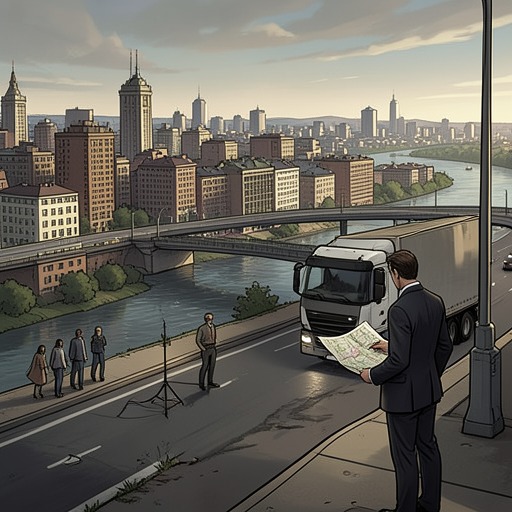
Temple’s Fertile Enclave
Gang Up: A Bikerland NovelTemple’s Fertile Enclave is a rare pocket of agricultural and commercial productivity in a wasteland where fertile ground is scarce. That abundance makes Temple more than a place to live: it is a prize whose farms, trade, water, and strategic position attract rival powers. Yet the town’s value is also a vulnerability. The Family can secure its own compound, but much of Temple remains exposed to the forces that want to control it.
Setting and Material Foundations
Temple lies in the hot badlands of what was once Texas, in a region the narrative distinguishes from the areas where the Long War spread. It is one of only five or six towns known to its inhabitants. Traders bring stories of shielded supercities to the east and north, while nearby Dallas is associated with law and order; Abigail has never visited it. Temple’s own order, by contrast, is determined by the Family. Its importance comes partly from its exceptional capacity to support farming and commerce in a devastated landscape.
The town’s built environment reflects both that value and its precariousness. Its broken-concrete streets are patched with gravel and sometimes black pitch. A few durable buildings—the bank, armory, and temple—stand among boards, clay structures, and tents outside the Family’s Compound. The Compound itself is made of squat concrete buildings reinforced with steel and layered with lead, a shelter against the world’s persistent radiation. This contrast gives Temple two distinct conditions: a protected center and a much larger, vulnerable town around it.
The eastern edge of Temple, outside the walls, is the Temple Shantytown, where Brall and the Cauldron hold sway. The enclave is therefore not a unified sanctuary under uncontested control. Its productive land sits beside competing centers of power, and the people who live beyond the Family’s secure perimeter cannot rely on the Compound’s protection in the same way as those inside it.
Wealth, Rule, and Unequal Protection
Temple’s fertility has economic and political consequences. Farming can sustain settlement, while commerce makes the town a point of exchange and a source of revenue. Brall sees the surrounding ground as useful not only for cultivation and trade but also for drugs and guns. The same abundance can thus support ordinary production and the armed networks seeking to command it.
The Family’s own economy reaches beyond the town. Its members raid surrounding territories for land, loot, and women to trade. Family members receive first choice, followed by those favored by the Family, known as the Kin, and then Temple’s ordinary residents, provided they pay taxes. Anyone may live in Temple, but only taxpayers receive the full benefits of protection under the Family’s rule. The arrangement links security to extraction: the Family claims to serve the town, while access to its protection is conditional and its spoils are distributed through a hierarchy.
That hierarchy has a spatial edge. When a crowd gathered outside the Compound walls demanding entry, guards ordered them home and threatened to open fire. A cleared strip around the walls, standing warnings, and the confiscation of caravans or wagons that obstructed the perimeter all reinforced the Family’s control of access. These measures might protect the Compound, but they also show why the fertile town beyond it could remain unsafe even when the Family’s own stronghold was secure.
A Prize That Invites Conflict
The death of Titus removed the leader who had kept Brall at bay. Titus had held the Family together through his strength and confidence, and his experience had made him difficult for Brall to outmaneuver. With him gone, Brall set his sights on taking Temple permanently. The enclave’s fertility helped explain the ambition: its value was too substantial for a rival power to ignore.
Brall and Carthage had long planned to take the town for the Cauldron. Brall’s desire to claim Abigail intensifies his personal interest, but the plan is not simply a private pursuit: Temple’s productive land and commercial potential remain central to what the Cauldron hopes to gain. The narrative places that desire beside a practical obstacle. Brall recognizes that he cannot simply burn down a town his side intends to possess. Its fertility makes destruction tempting as an expression of anger, but conquest requires preserving what makes the place valuable.
The conflict exposes the difference between a secure stronghold and a secure territory. The Family’s Compound can be fortified, supplied, and defended, while Temple itself remains open to pressure. Robin’s circumstances elsewhere within the Family’s protected spaces echo that uneven security, but the clearest material contrast comes when the Compound is bombed: an enormous fire erupts against its southern wall, and Case’s first concern is the garage and the people who may still be inside. The enclave’s defenses are formidable, not invulnerable.
War, Resources, and the Shape of Peace
Control of Temple depends on more than walls. Brall maintains a force of more than seventy-five soldiers, with roughly another hundred people attached to them as partners, merchants, or hangers-on. He trains the soldiers in commands, formations, attack positions, and mock battles, treating discipline as essential to feeding and holding together a force of nearly two hundred people. Such organization makes the Cauldron a serious contender for the town, not merely a band drawn by its wealth.
Water is another strategic resource. Near dusk, Brall’s forces attack the spring, overcoming its armed Family guards through surprise and the defenders’ disadvantage in the setting sun. The fighting is brief but costly: Brall loses two men and the Family five. The survivors surrender and are chained, leaving Brall the option of selling them back or using them as hostages in negotiations. He also considers clemency necessary if he is to rule the people he has conquered. The episode makes the enclave’s material basis concrete: control of a fertile town can still turn on access to a guarded source of water.
The war eventually moves toward openly defined terms rather than an indefinite sequence of ambushes and gradual encroachment. Case proposes joint rule in which council members have votes and each side can exercise a veto; later, the sides agree to meet in open battle outside town. The proposed council arrangement and the battlefield terms are distinct attempts to settle the same central question: how competing powers can govern a place neither can safely treat as worthless.
The eventual settlement gives the Cauldron responsibility for trade routes between Temple and Dallas and for routes to other communities Temple may contact. In return, the Cauldron will answer calls for help if Temple faces hostilities, and its troops will receive access to the Compound’s supplies and lodgings when they are in town. The Family, meanwhile, retains control of Temple and responsibility for its security; its riders will explore the wasteland, raid ruins for materials, and represent the town to the outside world. The arrangement turns Temple’s fertility and location into the basis for a division of labor: the Cauldron’s disciplined force protects and connects the routes, while the Family keeps its hold on the town and its outward expeditions.
Significance
Temple’s fertility is not a pastoral refuge detached from the violence around it. It is an economic resource, a military objective, and a test of political power. Farming and commerce make the town worth defending and worth capturing; the spring, trade routes, and protected Compound show the practical means through which that struggle is fought and negotiated.
The final alliance does not erase the conflict or make the town’s different zones equally safe. Instead, it converts rivalry into an arrangement that recognizes both powers’ interests: the Family retains Temple and its security role, while the Cauldron gains regular work, lodging, supplies, and responsibility for trade routes. The enclave’s defining condition is therefore a tension between productivity and exposure. Temple can sustain a future in the wasteland, but its abundance makes that future dependent on how rival organizations divide protection, resources, and authority.